좋은 문장
- The goal of few-shot learning is not to recognize a fixed set of labels but to learn how to quickly adapt to new tasks with a small amount of training data.
- For a unified taxonomy, we refer the reader to [4, 38].
Abstract
- 본 논문에서는 kernel과 hypernetwork paradigm의 fusion인 Hypershot 을 제안
- 기존 gradient를 기반으로 parameter를 조정하는 접근방식과 비교하여,
- 본 논문의 모델의 목표는 task’s embedding에 따라 classification module을 switch하는 것이다
- 실제로, 본 논문은 support set으로부터 aggregated information을 입력으로하고 classifier parameter를 반환하는 Hypernetwork를 이용
- 게다가 Hypernetwork의 입력으로 사용하는 support examples의 kernel을 기반 representation을 소개
- 결과적으로 backbone model이 제공하는 직접적인 feature value 대신에, support examples의 임베딩 간의 relation에 의존
1. Introduction
- Few shot learning의 목표는 fixed labels을 인식하는 것이 아니라, 적은 양의 training data를 가진 새로운 tasks에 빠르게 학습하는 방법을 학습하는 것
- Few shot learning 기술에는 2가지 기술이 있음
- kernel method and Gaussian processes
- Hypernetworks
- support set으로 부터 information을 aggregate하고 새로운 tasks에 대한 network weight를 생산
- 본 논문은 Hypernetworks paradigm과 kernel method를 결합
- 먼저, 전체 support set을 조사하고 각 class를 구별하기 위한 정보를 추출
- 그리고, feature를 기반으로 decision rule을 생성
[Process]
- backbone architecture를 통해 support set으로부터 feature를 추출하고, feature들 사이에 kernel values를 계산
- 그때 kernel representation을 입력으로 하고 classifier의 형태로 decision rule을 생성하는 Hypernetwork architecture를 사용
2. HyperShot: Hypernetwork for few-shot learning
2.1. Background
Few-shot learning
- Support set : $\mathcal{S}=\{
(x_l,y_l)
\}_{l=1}^L$ - $L$: task 내에서 같은 Class
- $K$: task 내에서 Class의 수
- Query set: $\mathcal{Q}=\{
(x_m,y_m)
\}_{m=1}^M$ - Task: $\mathcal{T=\{S,Q\}}$
2.2. HyperShot-overview
[Main idea]
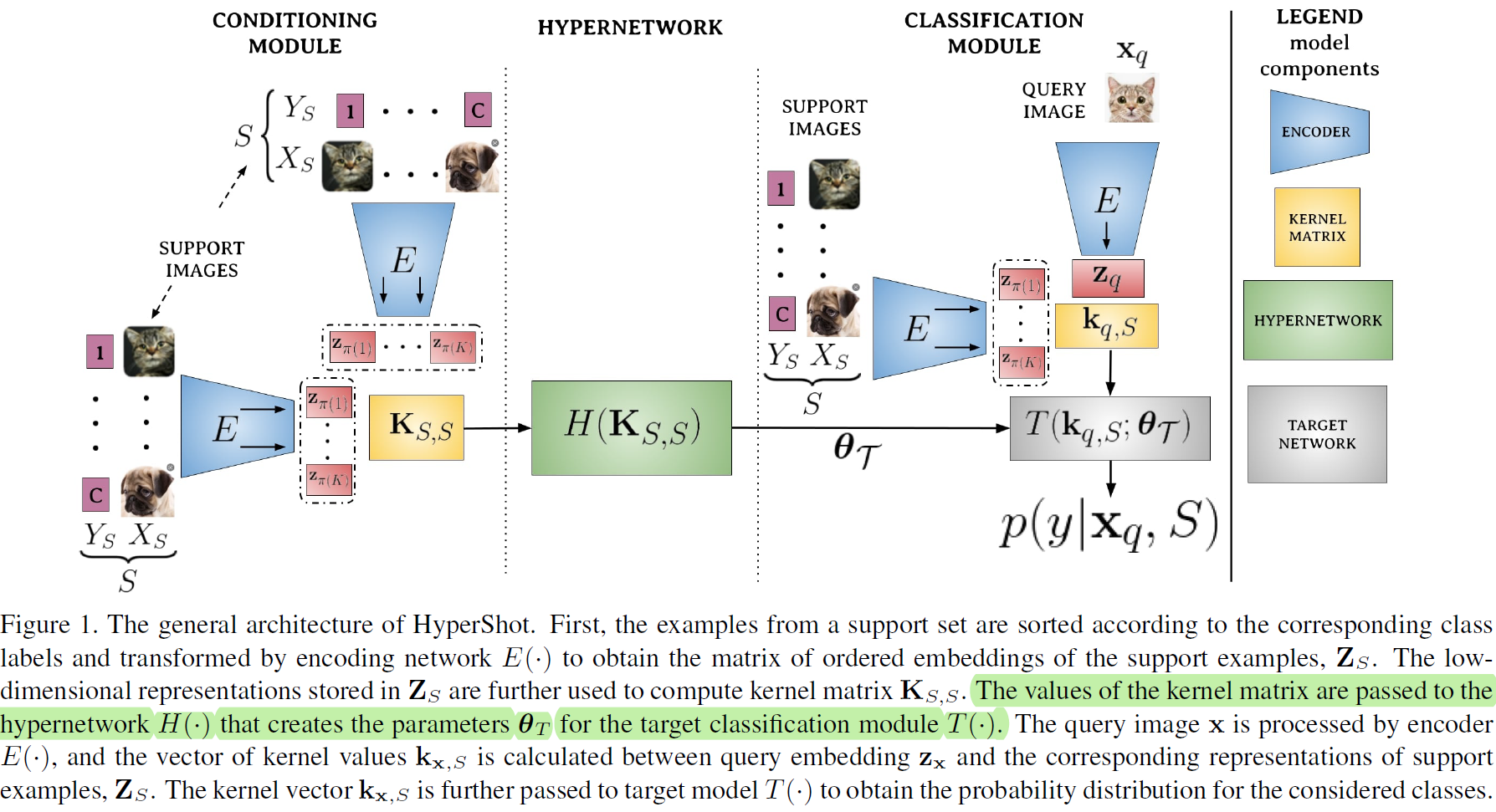
- Parameterized kernel function을 사용하여 support set으로부터 정보를 추출
- 결과적으로 training tasks와 차이가 큰 new task에 대한 embedding에 대해 robust
- Query image의 분류도 query image 관점에서 계산된 kernel value으로 수행됨
[Process]
[1] 먼저 Support set을 같은 class끼리 그룹화하여 encoder $E$를 통과하여 정렬
$$
\mathcal{S}={
(x_l,y_l)
}_{l=1}^L
$$
$$
E(x_l)=z_l
$$
$$
Z_s=[z_{\pi(1)},z_{\pi(2)},...,z_{\pi(K)}]^T
$$
- 여기서 $\pi(\cdot)$은 bijective function(일대일 대응 함수)
[2] 다음에는 $Z_s$의 row에 저장된 vector pairs에 대해 kernel matrix $K_{S,S}$를 계산
- 이를 위해 parameterized kernel function $k(\cdot,\cdot)$을 사용하고
- 각 $K_{S,S}$의 각 요소 $k_{i,g}$를 다음과 같이 계산

- 결과적으로 $K_{S,S}$는 support examples 사이에 관계에 대한 정보를 표현
[3] 그리고 $K_{S,S}$를 Vector 형태로 표현하여 Hypernetwork $H(\cdot)$의 input으로 사용
- Hypernetwork의 역할을 query object를 분류하는 taget model $T(\cdot)$의 parameter $\theta_T$를 제공
- Hypernetwork $H(\cdot)$으로 인해 gradient 없이 다양한 tasks 사이에 parameter를 switch할 수 있음
[4] Query image $x$는 다음과 같은 방식으로 분류
- Input image가 encoder $E(x)$에 의해서 low-dimensional feature representation $z_x$로 전환
- 그리고 Query embedding과 정렬된 support vector $Z_S$사이에 kernel vector $k_{x,S}$를 계산
$$
k_{x,S}=[
k(z_x,z_{\pi(1)}),
k(z_x,z_
{\pi(2)}),
...
k(z_x,z_{\pi(K)})
]
$$
- $k_{x,S}$는 target model $T(\cdot)$에게 제공
- target model 는 Hypernetwork $H(\cdot)$에 의해 생성된 parameter $\theta_T$를 사용
- target model은 각 class에 대한 probability distribution을 return $p(y|S,x)$
2.3. Kernel function
- 본 논문의 핵심 Component는 kernel function $k(\cdot,\cdot)$
- kernel function은 MLP model로 표현된 parameterized transformation function일 수 있고, identity operation($f(z)=z$)일 수 도 있고, dot product 일 수 있다
- 본 논문에서는 dot product를 사용

2.4. Training and prediction
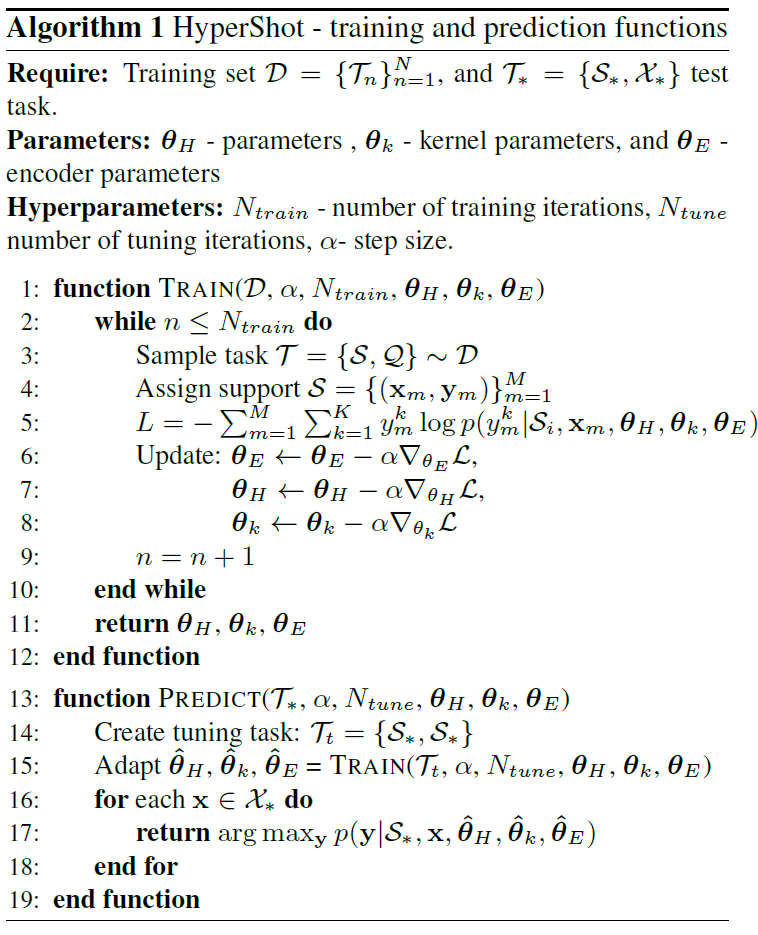
- $E := E_{\theta_E}$
- $\theta_E$: Encoder의 parameter
- $H=H_{\theta_H}$
- kernel function $k$ by $\theta_k$
- During the training stage,
- $\theta_H,\theta_k,\theta_E$가 cross-entropy loss $L$로 최적화
- During the inference stage,
- task $\mathcal{T}*$은 labeled support examples $\mathcal{S}$과 unlabelled query examples $\mathcal{X}_*$로 구성
- probability value $p(y|\mathcal{S}_*,x)$ 계산하며 참고로 $x$는 $\mathcal{X}_*$에 포함
2.5. Adaptation to few-shot scenarios
- 본 논문에서는 task adatpation을 수행할 때 $\theta_H,\theta_k,\theta_E$를 조금 tuning하는 것이 성능에 좋다라는 것을 관측
- 따라서 support set 예제로 adaptation task $\mathcal{T}i=\{
\mathcal{S}_*,
\mathcal{S}_*
\}$를 구성하여 $\theta_H,\theta_k,\theta_E$를 tuning - 이때 order function $\pi(\cdot)$ 대신에, “A closer look at few-shot video classification”을 따라 같은 class의 support examples $z$에 aggregation function을 적용
- aggregation function 덕분에 kernel matrix는 encoding network의 latent space에서 aggregated된 value를 기반으로 계산됨
- aggregation function은 fine-grained와 averaged를 사용했는데, averaged가 더 좋았음

4. Experiments

Reference
https://arxiv.org/abs/2203.11378
HyperShot: Few-Shot Learning by Kernel HyperNetworks
Few-shot models aim at making predictions using a minimal number of labeled examples from a given task. The main challenge in this area is the one-shot setting where only one element represents each class. We propose HyperShot - the fusion of kernels and h
arxiv.org
'Meta learning' 카테고리의 다른 글
| FeLMi : Few shot Learning with hard Mixup (0) | 2025.05.01 |
|---|---|
| 메타러닝 Dataset setting (0) | 2025.04.09 |
| Any-Way Meta-Learning (0) | 2024.12.03 |
| Learning to Learn from APIs: Black-Box Data-Free Meta-Learning (0) | 2024.11.24 |
| META-KNOWLEDGE EXTRACTION: UNCERTAINTY-AWARE PROMPTED META-LEARNING (0) | 2024.10.31 |