Abstract
- aligment problem?
- this paper proposes diffusion latent beam search with estimator
- which can select a better diffusion latent to maximize a given alignment reward at inference time.
- This paper point out that improving video quality with respect to alignment to prompts requires reward calibration by weighting existing metrics.
1 Introduction
- Recently, it has attracted a lot of attetion to 1) steering the output of diffusion models , 2) quantifying the goodness of the content.
- which is studied as an alignment problem.
- This paper proposes Diffusion Latent Beam Search (DLBS) with lookahead estimator
- which can select a better diffusion latent to maximize a given aligment reward
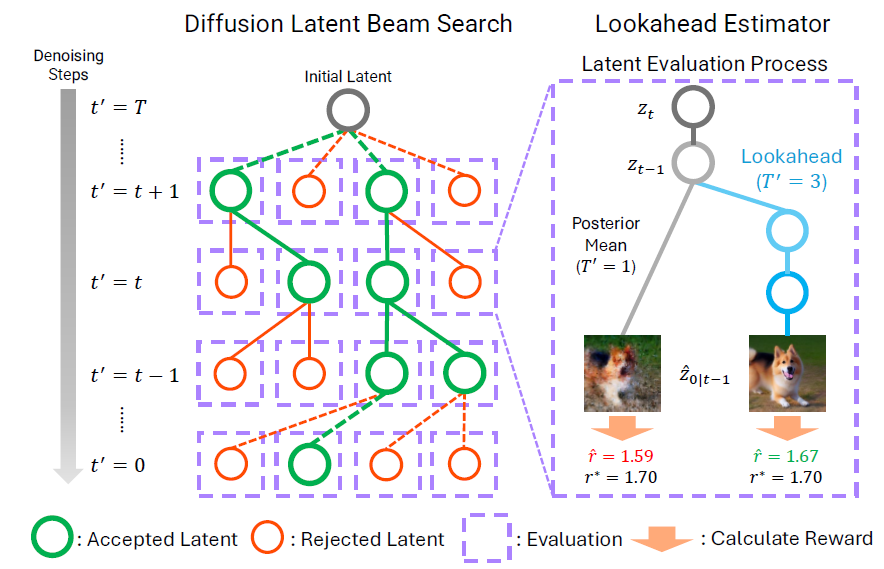
- This paper also point out that
- the improvement of perceptual video quaility, considering the alignment to prompt, requires reward calibration of existing method.
- Because many previous metric for quantifying video naturalness do not always correct between vision language and human raters
- We demonstrate that DLBS can induce high-quality outputs based on the calibrated reward

2 Preliminaries.
Latent Diffusion Models
1. forward process
$$
p_0(\mathbf{z})
\longrightarrow
p_t(\mathbf{z})
\longrightarrow
p_T(\mathbf{z}) \approx \mathcal{N}(0,I).
$$
- $p_0(\mathbf{z})$: clean latent data distrubution
- $p_t(\mathbf{z})$: partially noised distribution
- $p_T(\mathbf{z})$: nearly Gaussian-noise distribution
$$
z_0 = \operatorname{Enc}(x_0)
$$
$$
d\mathbf{z}=\mathbf{f}(\mathbf{z}, t),dt+g(t),d\mathbf{w},\quad\text{where }\mathbf{z}_0 \sim p_0(\mathbf{z}).
$$
$$
\underbrace{z_{t+1}-z_t}_{dz} = \underbrace{f(z_t,t)\Delta t}_{\text{drift}} + \underbrace{g(t)\sqrt{\Delta t}\,\epsilon}_{\text{Gaussian noise}}, \qquad \epsilon\sim\mathcal{N}(0,I)
$$
- Expression that I’m familiar
$$
z_t = \sqrt{\alpha_t},z_{t-1} + \sqrt{1-\alpha_t},\epsilon.
$$
- $\sqrt{\alpha_t},z_{t-1}$ : slightly weakens the existing latent signal → drift-like deterministic change
- $\sqrt{1-\alpha_t},\epsilon$ : adds Gaussian noise → random change
2. Reverse diffusion process
$$ p_T(\mathbf{z}) \approx \mathcal{N}(0,I) \longrightarrow p_t(\mathbf{z}) \longrightarrow p_0(\mathbf{z}) $$
- The reverse process starts from Gaussian noise and repeatedly uses the learned score to move the latent toward the prompt-conditioned video distribution.
$$
d\mathbf{z}=\left[\mathbf{f}(\mathbf{z},t)-g(t)^2 \nabla_{\mathbf{z}} \log p_t(\mathbf{z})\right]dt+g(t),d\mathbf{w},
$$
Original drift
$$
\mathbf{f}(\mathbf{z},t)
$$
Diffusion coefficient
$$
g(t)
$$
$g(t)$ is the diffusion coefficient, which determines the noise scale at diffusion time $t$.
Score function
$$
\nabla_{\mathbf{z}}\log p_t(\mathbf{z})
$$
This function tell the current noisy latent which direction lead more realistic video latents.
$$
z_t\xrightarrow{\nabla_{\mathbf{z}} \log p_t(\mathbf{z})}\text{high-probability region}
$$
- Why does $z_t$ have to move toward a high-probability region ?
- Because high-density regions represent latent patterns that are more typical of the model’s traning data at time $t$.
Score-based correction
$$
-g(t)^2 \nabla_{\mathbf{z}} \log p_t(\mathbf{z})
$$
Reverse-time noise
$$
g(t),d\bar{\mathbf{w}}
$$
Reference
https://arxiv.org/abs/2501.19252
Inference-Time Text-to-Video Alignment with Diffusion Latent Beam Search
The remarkable progress in text-to-video diffusion models enables the generation of photorealistic videos, although the content of these generated videos often includes unnatural movement or deformation, reverse playback, and motionless scenes. Recently, a
arxiv.org
'Diffusion' 카테고리의 다른 글
| Adding Conditional Control to Text-to-Image Diffusion Models (0) | 2025.12.09 |
|---|---|
| Diffusion 수식 (0) | 2025.12.02 |