Abstract
- Video generation의 physics plausibility 개선 문제를 inference-time alignment로 다룬다
- 특히 latent world model의 physics prior를 이용
1. Introduction
2. Methodology: WMReward
2.2. Steering for Better Physics Plausibility
$$
p^{*}(x) \propto w(x)p(x),
$$
- $p(x)$는 pre-trained video model distribution
- $w(x)$는 reward $r(x)$로부터 구축된 weighting function
2.3. Latent World Model Reward Signal
- 본 논문에서는 VJEPA를 Reward model로 바꾸기 위해 단순한 직관을 사용
- [직관]
- V-JEPA는 월드 모델이므로, 물리적으로 타당한 영상에서는 주어진 과거로부터 미래를 비교적 잘 예측할 수 있어야 한다.
- 따라서 V-JEPA가 예측한 미래와 생성 영상에서 실제로 나타난 미래가 크게 다를수록, 해당 영상은 물리적으로 부자연스러울 가능성이 크다고 판단한다.
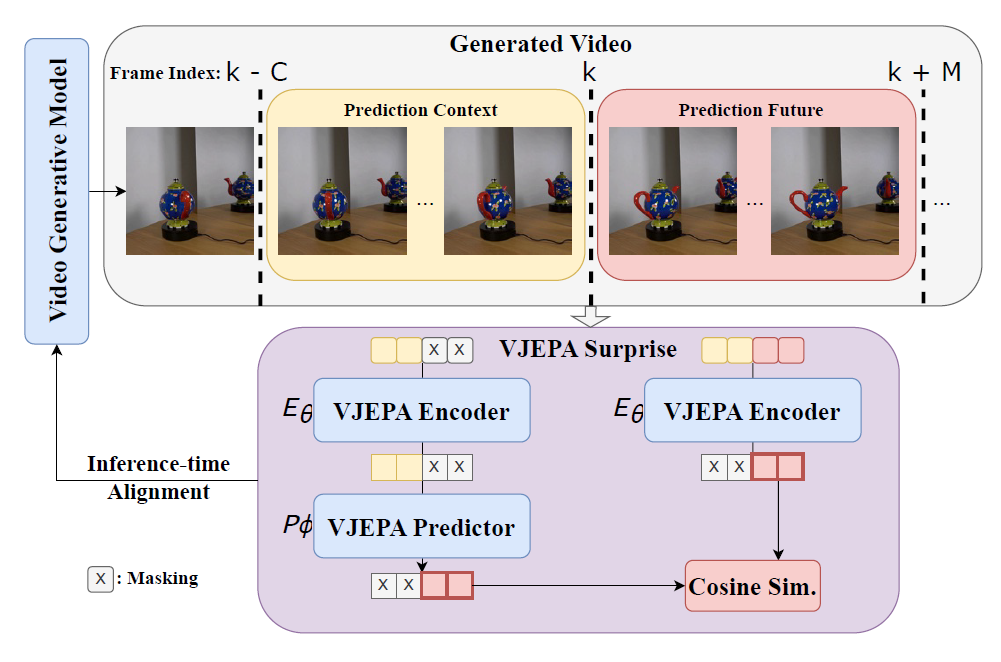
- VJEPA는 context frames $x^{k-C+1:k}$를 관측하고,
- Future frames $x^{k-C+K+M}$에 대한 representation을 예측해야한다.
- 즉 아래 두 식이 유사해야한다. ($\hat{z_k} = z_k$)
$$
\hat{z}k = P{\phi}\left(\Delta_m, E_{\theta}\left(x^{k-C+1:k}\right)\right),
$$
$$
z_k = E_{\theta}\left(x^{k-C+1:k+M}\right).
$$
- 그렇게 되면 r(x)를 아래와 같이 구할 수 있다.
- $\mathcal{K}$는 모든 windows
$$
r(x) = \frac{1}{|\mathcal{K}|}
\sum_{k \in \mathcal{K}}
\left(1 - \cos\left(\hat{z}_k^{\mathrm{fut}}, z_k^{\mathrm{fut}}\right)\right),
$$
2.4. Instantiation of Sampling Schemes
(i) Guidance ($\nabla$)
$$
\nabla_{x_t} \log p_t(x_t)
+
\nabla_{x_t} \log
\mathbb{E}\left[
e^{\lambda r(x_0)}
\mid x_t
\right].
$$
(ii) Best-of-N Search (BoN)
- 같은 프롬프트에 서로 다른 초기 노이즈, 즉 서로 다른 seed를 사용하여 여러 영상을 생성
$$
x^{*}
=
\underset{x \in {x^{(i)}}_{i=1}^{N}}{\arg\max}
, r(x).
$$
(iii) $\nabla$+ BoN
3. Experiments
3.1. Image and Multiframe-conditioned Generation
Comparing Reward Signals.
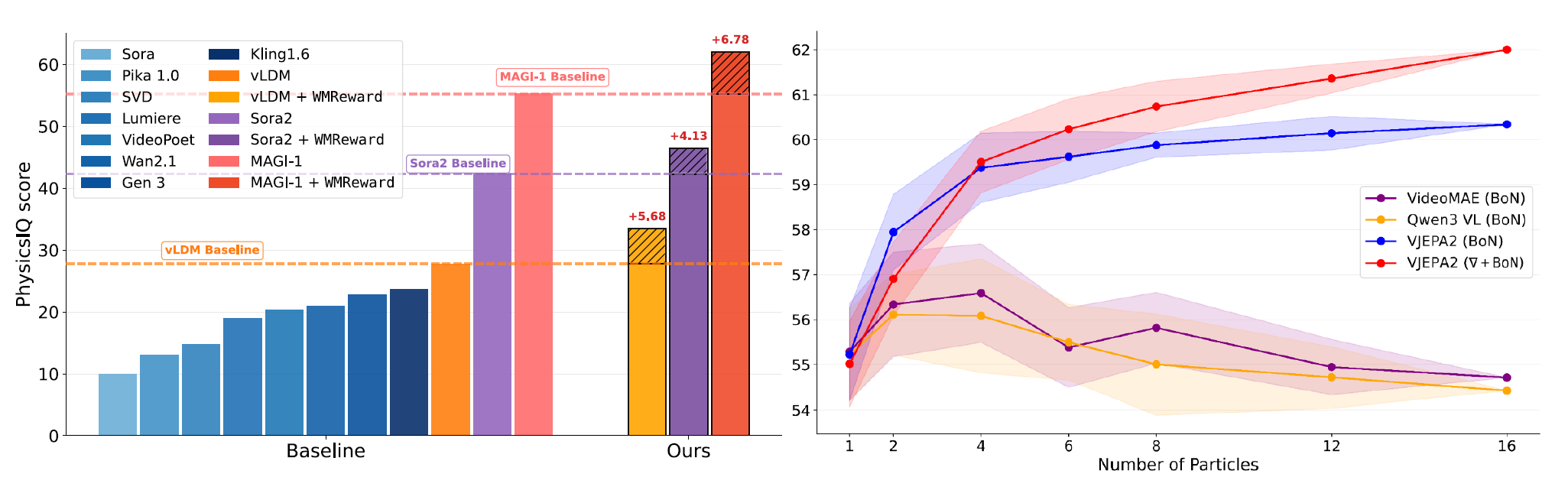
- latent world model에 담긴 physics knowledge가 보상 신호로 활용되어 비디오 생성 성능을 향상시킬 수 있음을 보여줌
Reference
https://arxiv.org/abs/2601.10553
Inference-time Physics Alignment of Video Generative Models with Latent World Models
State-of-the-art video generative models produce promising visual content yet often violate basic physics principles, limiting their utility. While some attribute this deficiency to insufficient physics understanding from pre-training, we find that the sho
arxiv.org